(+91) 70037 62594 | (+91) (033) 4603-5857 | (+91) (033) 2530-1971
 info@nopanyhigh.com


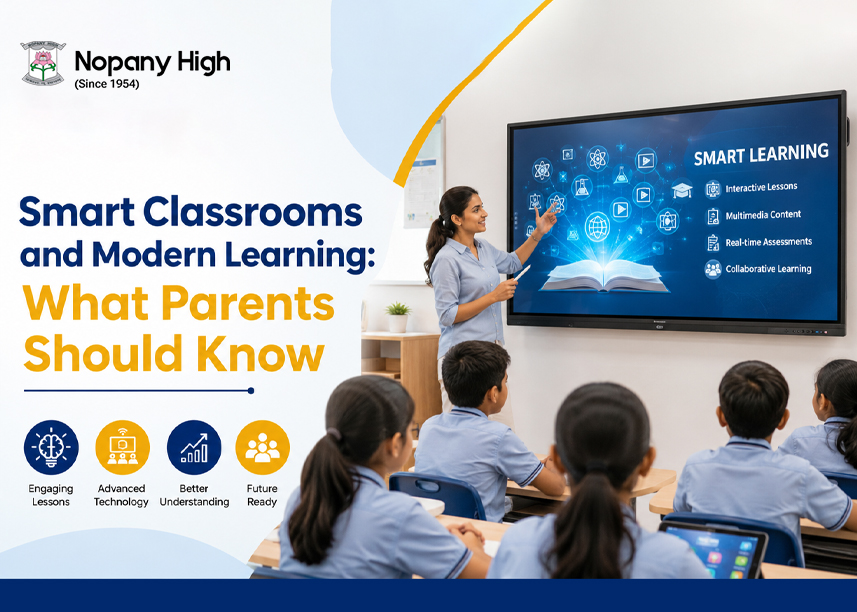
"Smart classroom" has become one of those terms every school prospectus mentions, but what it actually means — and how much of a difference it makes to a child's learning is worth understanding beyond the marketing language.
What a Smart Classroom Actually Is
A smart classroom is an environment that is geared towards replacing or supplementing the blackboard and text book system with digital tools such as interactive displays, projected visual content, audio-visual aids and, in some cases, internet-enabled devices that allow for the real-time delivery of content during a lesson.
It's not about the technology, but about what the technology allows that a chalkboard can't:
- For topics such as Geography, biology or physics, where diagrams and interactive learning models can convey knowledge more quickly than a still image in a book.
- Multimedia content — videos, audio clips, and animations that hold attention differently than a lecture-style explanation
- Real-time adaptability — a teacher can pull up a relevant example, map, or data set on the spot rather than being limited to what's printed in a textbook
- Better retention — students generally engage more with content they can see and interact with, compared to purely text-based teaching
Why This Matters More at Certain Ages
Smart classroom infrastructure tends to make the biggest difference for subjects that are inherently visual or spatial — science diagrams, geographical maps, historical timelines — and for younger students who benefit from more engaging, less text-heavy instruction. For senior students preparing for board exams, it's often more useful as a supplement to focused, exam-oriented teaching rather than a replacement for it.
What to Actually Check When Evaluating a School
Given how commonly the term gets used, it's worth looking past the label and checking the actual smart classroom facilities in school before assuming every "smart" tag means the same thing:
- Does all of a school have a smart classroom or just some?
- Do they become part of the curriculum for daily use or are they only used occasionally to demonstrate?
- What infrastructure is available – interactive boards, projectors or additional screens?
- Has the school invested in this recently, or is the infrastructure several years old?
At Nopany High
Nopany High has been expanding its classroom infrastructure to support more visual, interactive teaching across grades. You can see what's currently in place and what's planned on our new developments page.
Infrastructure is only one part of the picture, though it's worth looking at this alongside our syllabus and activities pages to get a fuller sense of how a school approaches learning day to day.